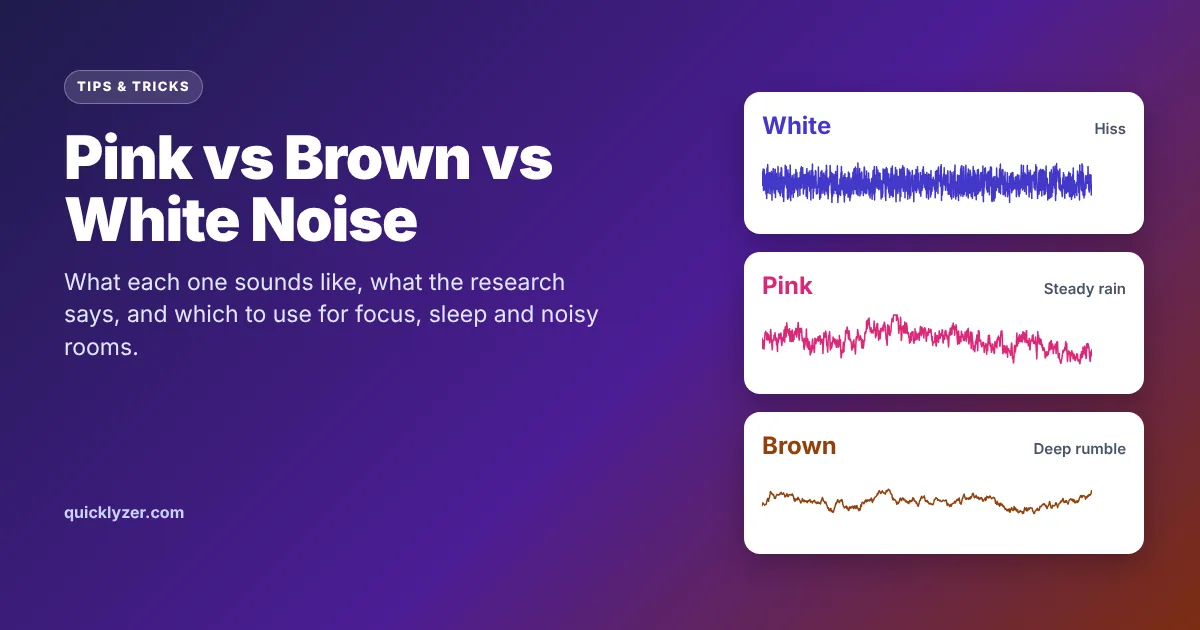
White, pink and brown noise all sound like steady static at first. Listen for a minute, though, and they are clearly different. White noise hisses like an untuned radio, pink noise sounds like steady rain, and brown noise rumbles like distant surf. The difference comes from one thing only: how the sound’s energy is spread from low to high pitches. That spread decides which noises each one covers up, how tiring it is to listen to, and what it is useful for.
This post compares the three side by side, using real recordings from our free Focus Sounds mixer, and sorts the research from the hype on sleep, babies, tinnitus and concentration.
The Quick Answer
| White noise | Pink noise | Brown noise | |
|---|---|---|---|
| Sounds like | Radio static, a hissing kettle, an air vent | Steady rain, a waterfall, wind in leaves | Distant surf, a strong shower, a plane cabin |
| Energy | Equal at every frequency, so mostly high-pitched | Equal in every octave, so balanced | Mostly in the low octaves |
| Covers best | Voices, high-pitched sounds | Voices and general room noise | Traffic, footsteps, bass from next door |
| Downside | Can feel harsh after a while | Less effective on deep rumbles | Weak on high-pitched sounds |
| Research | The most studied of the three | Studied for sleep, with mixed results | Barely studied on its own |
If you only remember one rule: choose the noise whose energy sits where the sound you want to hide sits. Then pick whichever of the suitable ones you find easiest to live with.
What Makes Noise White, Pink or Brown?
All three are random sound that contains every audible pitch at once. That is why they hide other sounds so well. What changes is the balance between low and high pitches, and the clearest way to see it is in octaves. An octave is a doubling of frequency, for example from 500 Hz to 1,000 Hz. Our ears hear every octave as the same step in pitch, but the higher octaves contain far more individual frequencies than the lower ones.
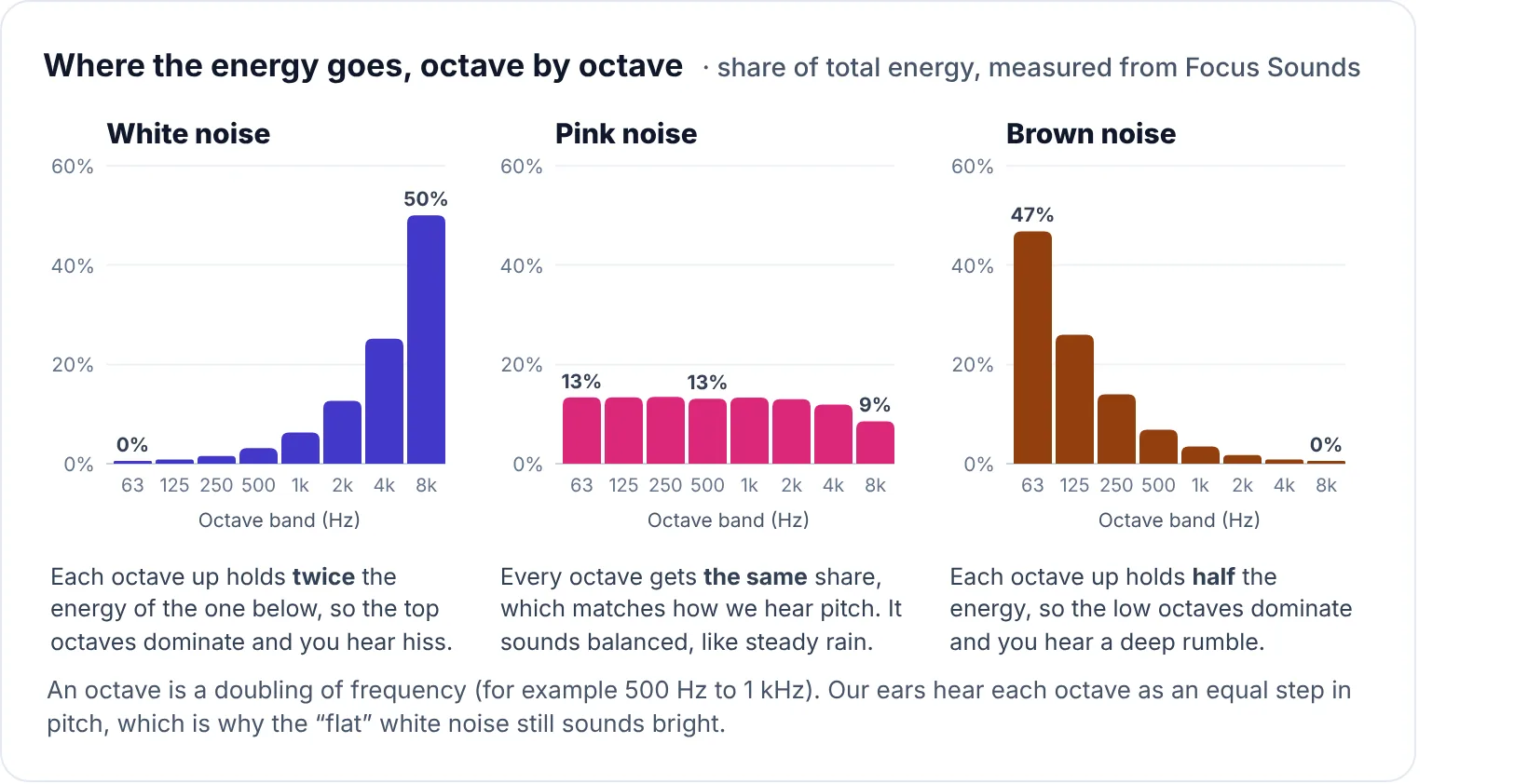
- White noise gives every single frequency the same power. Because each octave up has twice as many frequencies, it also has twice the energy. In our recording, the top octave alone holds half of all the energy, which is why white noise sounds like a hiss even though it is technically “flat”.
- Pink noise turns the power down by 3 decibels with every octave. That exactly cancels the doubling, so every octave gets the same share, about 13% each in our measurement. Because that matches the way we hear, pink noise sounds even and natural. Many natural sounds, such as rain and rustling leaves, are close to pink.
- Brown noise turns the power down by 6 decibels per octave, so each octave up has half the energy of the one below. Almost half of the energy sits in the lowest octave. Despite the name, it has nothing to do with the colour: it is named after the botanist Robert Brown, because the signal moves like a particle in Brownian motion. It is also called red noise.
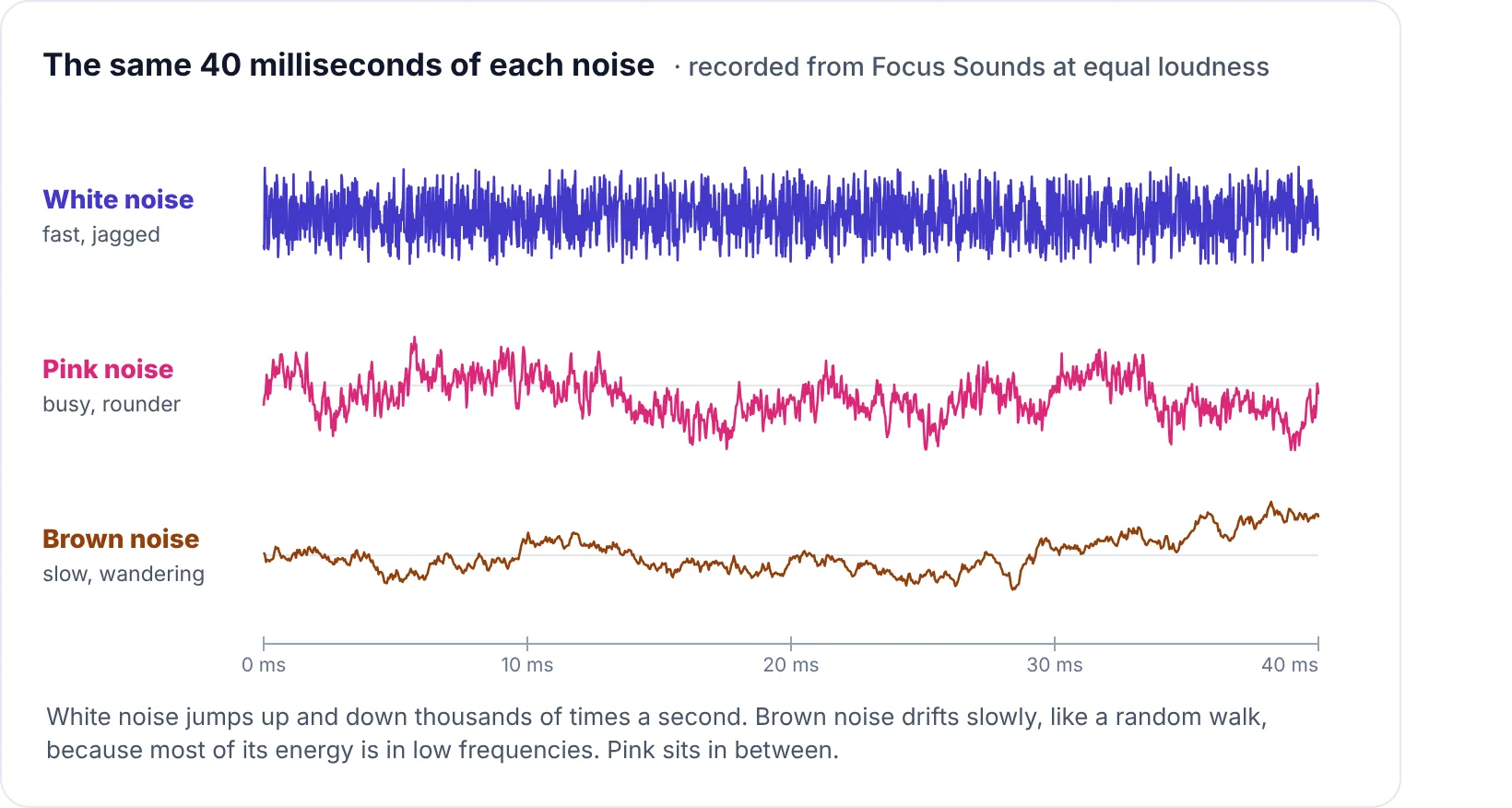
You can see the same difference in the sound wave itself. Fast changes are high pitches and slow swings are low ones:
Which Noise for Which Problem
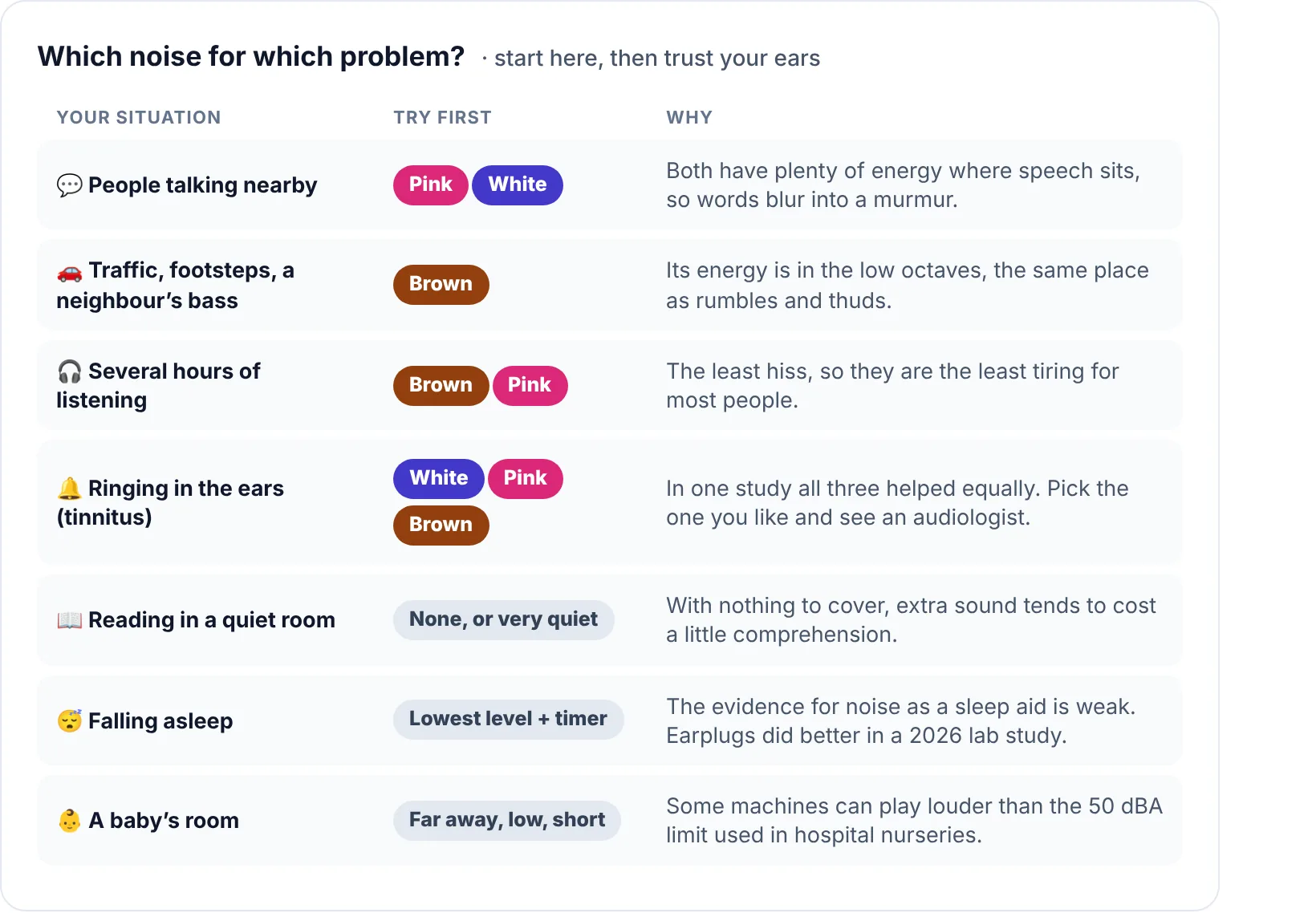
A noise works by masking: it fills the same frequencies as the sound that bothers you, so your brain no longer picks that sound out. That gives a simple way to choose.
Voices and office chatter
Speech carries most of its energy and nearly all of its meaning in the middle and upper frequencies. White and pink noise both cover that range well. Pink is the better all-day choice for most people because it lacks the sharp top end. For the full step-by-step method for working in noise, including volume and timers, see our guide on how to use background noise to focus.
Traffic, footsteps and a neighbour’s music
Engines, thuds and bass notes live in the lowest octaves, which is exactly where brown noise puts its energy. White noise is a poor fit here: you would need to play it loudly before it covered a rumble, and by then the hiss itself becomes the problem.
Ringing in the ears
Sound therapy is a common way to make tinnitus less intrusive. In a small study of tinnitus retraining therapy, people who could choose white, pink or red (brown) noise improved just as much as people given white noise only. Two-thirds preferred white noise, and the rest chose red. The colour seems to matter less than finding a sound you are happy to use, so treat the choice as personal and get tinnitus checked by a doctor or audiologist.
Pink Noise and Sleep: What the Research Really Says
Pink noise is often sold as a sleep aid “backed by science”. The science is real, but it mostly tested something different from what a sleep app plays.
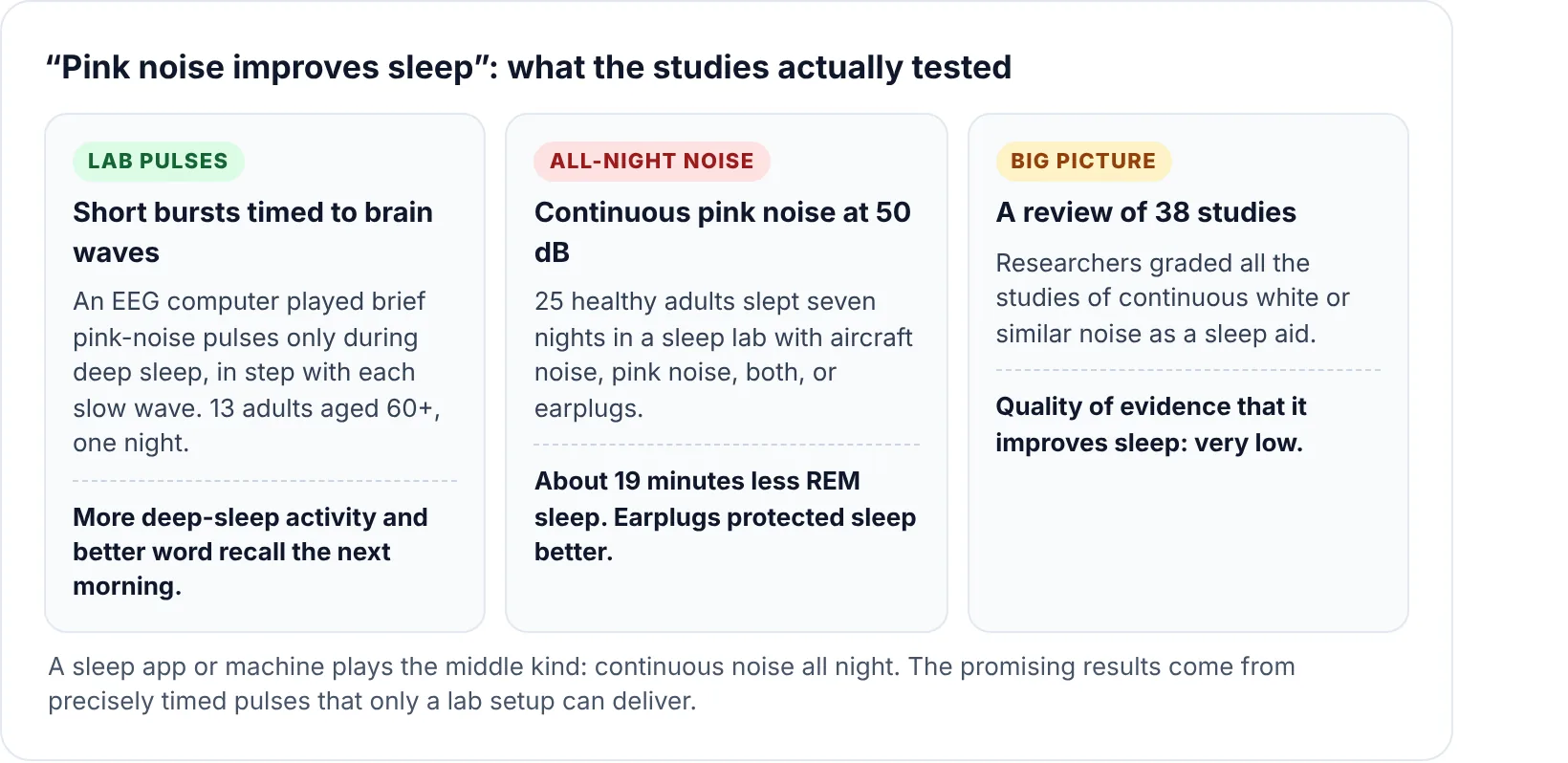
- Timed pulses can deepen sleep. In a Northwestern University study, a computer read the brain waves of 13 adults aged 60 to 84 and played short bursts of pink noise only in step with their deep-sleep waves. Deep-sleep activity increased and word recall the next morning improved. An app cannot do this, because it does not know what your brain is doing.
- Continuous noise may cost you REM sleep. In a 2026 University of Pennsylvania study published in Sleep, 25 healthy adults spent seven nights in a sleep lab. Pink noise played all night at 50 dB, about the level of moderate rain, came with roughly 19 fewer minutes of REM sleep. Combined with aircraft noise, it shortened both deep and REM sleep. Earplugs did a better job of protecting sleep from the aircraft noise.
- The overall evidence is thin. A 2021 review of 38 studies on continuous white or similar noise as a sleep aid rated the quality of evidence that it improves sleep as very low. Some studies even found that it disturbed sleep.
None of this means you must give up a sound you rely on. If noise helps you drift off in a loud flat, use the lowest level that still hides the disturbance and set a timer so it fades out after you fall asleep. Try earplugs as an alternative, especially if your bedroom is quiet anyway.
A note on babies
Infant sleep machines are popular, but a study in Pediatrics measured 14 of them at full volume. All 14 were louder than 50 dBA, the limit used in hospital nurseries, when measured at crib distance, and three exceeded 85 dBA. The authors advise placing the machine as far from the baby as possible, keeping the volume low and running it for a limited time. The Penn researchers also point out that children spend much more of their sleep in REM, so they may be more sensitive to all-night noise. Ask your paediatrician if you are unsure.
Is Brown Noise Better for ADHD?
Brown noise went viral as a way to “quiet the ADHD brain”. The research behind those claims mostly used white noise, not brown, and even there the benefit is small and does not apply to everyone. An expert interviewed by Cleveland Clinic notes that research on brown noise is minimal, and that no significant studies compare it with white or pink noise for ADHD. What brown noise genuinely has going for it is comfort. It has almost no hiss, so many people can leave it on for hours. If it helps you settle into work, that is a perfectly good reason to use it. Just don’t expect it to work like medication.
Beyond White, Pink and Brown
Several other noise colours exist. A few of them are proper technical terms, and others are mostly marketing:
| Colour | What it is | Sounds like |
|---|---|---|
| Blue | The opposite of pink: energy rises 3 dB per octave | A sharp, thin hiss |
| Violet | The opposite of brown: energy rises 6 dB per octave | A very high hiss, like spraying water |
| Grey | Shaped so that every pitch sounds equally loud to human ears | A smooth, even shush |
| Green | No standard definition. Usually means extra energy in the middle frequencies | Often described as nature or waterfalls |
| Black | Not a real noise. Usually means silence | Nothing |
For everyday use, white, pink and brown cover almost every need. The rest are variations on the same idea of tilting energy towards high or low pitches.
How to Compare Them in Five Minutes
Descriptions only go so far, because ears and rooms differ. The quickest way to choose is a short, fair listening test while the sound that bothers you is actually happening.
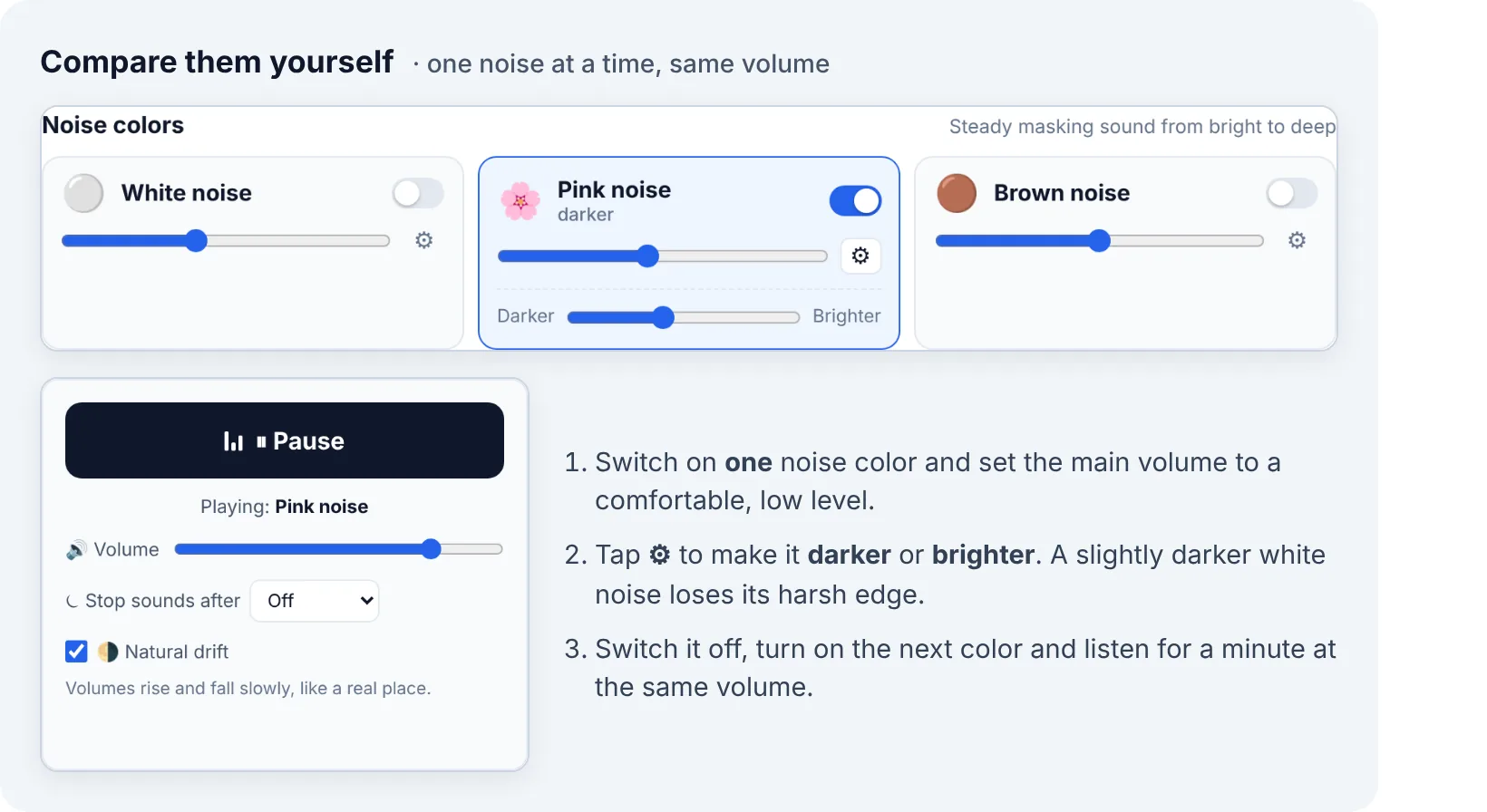
- Use the same device and volume for all three, at a level no louder than normal conversation.
- Listen to each one for a full minute. The first seconds of any noise sound odd, so give your ears time to adjust.
- Ask two questions: can I still hear the thing I wanted to hide, and would I happily leave this on for an hour?
- Fine-tune the winner. In Focus Sounds, each noise has a darker or brighter tone setting behind its ⚙ button, so a white noise that is too sharp or a brown noise that is too muffled can be nudged instead of dropped.
- Layer if needed. Voices and traffic at the same time? Combine pink and brown, or add a natural sound such as rain on top.
Three Myths Worth Dropping
- “Louder masks better.” Masking needs only enough level to cover the distraction. Anything more tires your ears and, over months, can harm your hearing.
- “Pink noise is scientifically proven to improve sleep.” The striking results used pulses timed to brain waves in a lab. All-night pink noise from a speaker has much weaker evidence, and one recent study found it reduced REM sleep.
- “Brown noise is best for everyone.” It is the most comfortable for many people, but it is the worst of the three at hiding voices.
Frequently Asked Questions
Which is best for sleep: white, pink or brown noise?
No colour has been shown to be best. If you need noise to hide sounds at night, choose by what you hear: brown for traffic and rumbles, pink for voices and general noise. Use the lowest level that works and a timer. If your bedroom is quiet, you may sleep better without any noise.
Why does white noise sound so harsh if it is “flat”?
Because it is flat across individual frequencies, not across octaves. Each octave up holds twice as much energy as the one below, so most of the sound ends up in the highest octaves, which we hear as hiss.
Is pink noise the same as rain?
Not exactly, but steady rain is close to pink, which is why the two are often compared. Real rain also has individual drops and splashes, which some people find more pleasant and others more distracting.
Can I listen to noise all day?
Yes, at a sensible volume. Keep it around the level of quiet conversation or lower, take breaks, and turn it off when the distraction is gone. Our focus guide explains how to find the lowest level that still works.
Is it safe to use white noise for a baby?
Researchers recommend caution. Keep the machine far from the cot, the volume low and the run time limited. Never place it in the crib or on the rail, and talk to your paediatrician if you rely on it every night.
Hear the Difference for Yourself
Open the free Focus Sounds mixer and switch on white, pink and brown noise one at a time. It needs no account, nothing is downloaded, and it runs in your browser. Keep the one that hides your distraction at the lowest volume.
Sources
- Riedy, Smith, Rocha & Basner (2021) — Noise as a sleep aid: A systematic review, Sleep Medicine Reviews
- University of Pennsylvania (2026) — Sound machines might be making your sleep worse (study in Sleep)
- Papalambros et al. (2017) — Acoustic enhancement of sleep slow oscillations and memory improvement in older adults, Frontiers in Human Neuroscience
- Hugh et al. (2014) — Infant sleep machines and hazardous sound pressure levels, Pediatrics
- International Tinnitus Journal — Effects of tinnitus retraining therapy with different colours of sound
- Cleveland Clinic — What is brown noise?