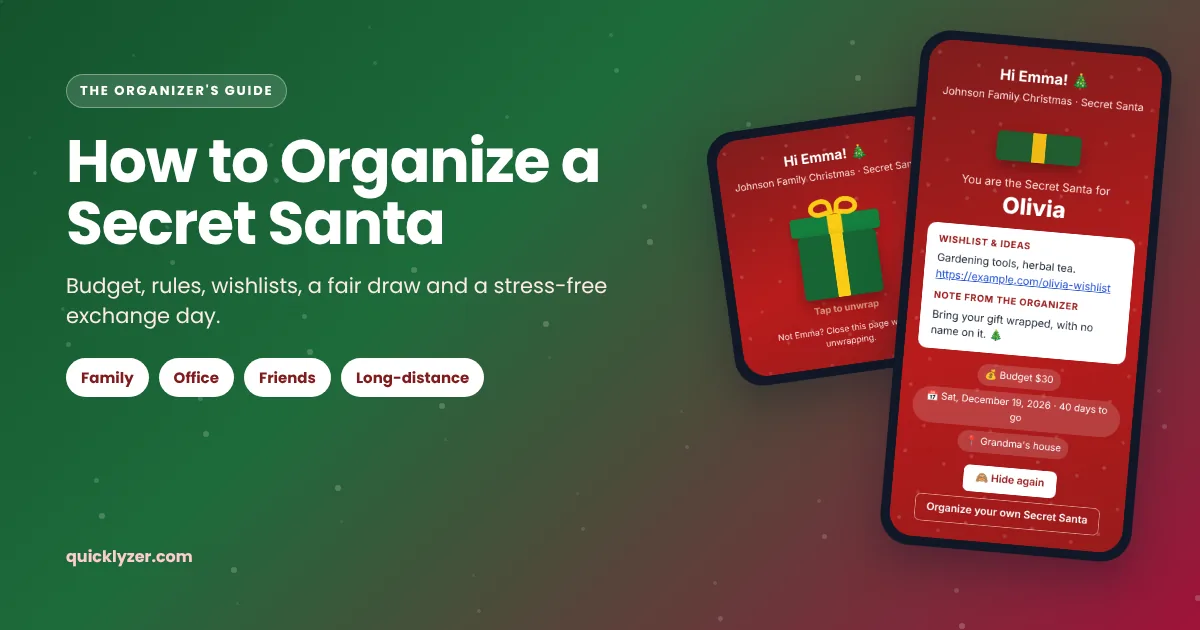
A Secret Santa sounds simple: everyone buys one gift for one person. In practice the organizer juggles a guest list, a budget nobody wants to argue about, couples who shouldn't draw each other, a colleague who joins late and an aunt who lives three time zones away. This guide walks you through the whole thing, from the first message to the group to the moment the last gift is unwrapped, with templates you can copy and fixes for the problems that usually come up.
It works for families, offices, friend groups, classrooms and long-distance exchanges. Where the draw itself comes in, the examples use our free Secret Santa Generator, which handles the matching and lets each person discover their match privately. The planning advice applies however you draw names.
What is Secret Santa?
In a Secret Santa, every participant is secretly assigned one other person to buy a gift for. You know who you're shopping for, but nobody knows who is shopping for them until the exchange, and sometimes not even then. Instead of everyone buying small presents for everyone, each person buys one thoughtful gift, which keeps costs down and makes large groups manageable.
The idea goes by many names. People in Ireland and Australia often call it Kris Kringle, in Germany it's Wichteln, in Brazil and Portugal amigo secreto and in Spain amigo invisible. Some American families know it as Pollyanna. The rules are almost always the same.
Secret Santa, White Elephant or something else?
Before you plan anything, make sure a Secret Santa is the format your group actually wants. The most common alternatives work quite differently:
| Format | How it works | Best for |
|---|---|---|
| Secret Santa | Each person draws one name and buys a gift for that person, often from a wishlist. | Groups who know each other: families, teams, friends. |
| White Elephant / Yankee Swap | Everyone brings one wrapped gift that would suit anyone. Players take turns opening a gift or stealing one that's already open. | Parties where people don't know each other well and want a game. |
| Themed swap | Everyone brings a gift in one category, such as a favorite book, a homemade treat or a plant, and gifts are handed out at random. | Book clubs, hobby groups and low-budget exchanges. |
| Family pool | Adults put money together for one bigger gift per child or per household. | Large families who want to cut spending on adults. |
If people want a personal gift and the fun of a secret, choose Secret Santa. If they mostly want a laugh, White Elephant is easier because nobody has to buy for a specific person.
Your Secret Santa timeline
The most common mistake is drawing names too late. People need time to think, order online and, for remote groups, ship. Count back from the exchange day:
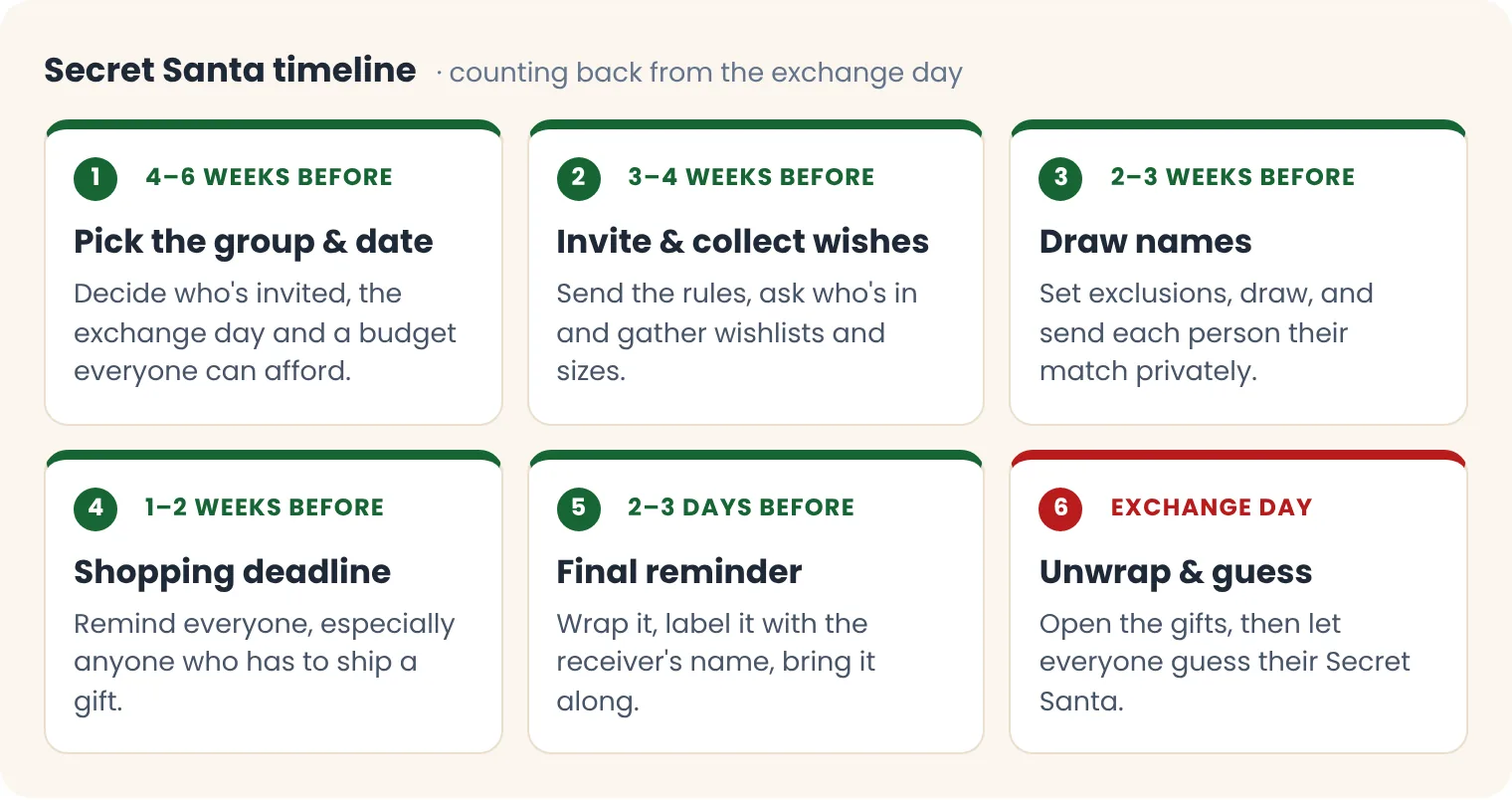
For an office exchange before a winter break, that usually means sending the first message in early November and drawing names by the end of November. Families who meet on Christmas Eve can draw in the first days of December.
Step 1: Decide who's in and when
Start with the basics, because they shape every later decision.
- Make it opt-in. Especially at work, ask who wants to join instead of signing everybody up. Some people can't afford it, don't celebrate or simply prefer not to take part, and that's fine.
- Any number works, from three people up. Odd numbers are no problem: with a proper draw, everyone gives exactly one gift and gets exactly one, whether there are 7 or 31 of you.
- Think about kids. Small children can't shop on their own. Either run a separate kids' exchange where parents help, or let each child be paired with an adult.
- Pick a date that people can make. The last working day before a break is popular in offices; families often tie it to a meal they already have planned. If not everyone can attend, plan how absent people receive their gift.
- Decide where the gifts are opened: at a party, around the dinner table, in the office kitchen or on a video call.
Step 2: Set a budget everyone can live with
A clear budget prevents the awkward moment when one person gets a cashmere scarf and another a keychain. Choose a single amount rather than a range, since “$20 to $50” quietly turns into “$50”. These are typical amounts in the US; adjust them to your group and currency:
| Group | Common budget | Why |
|---|---|---|
| Office or team | $15–$25 | Fair for every salary level, and nobody feels pressured. |
| Friends | $20–$40 | Enough for something personal without a big bill in December. |
| Adults in a family | $25–$50 | Replaces buying for every relative, so the total often goes down. |
| Kids or classroom | $5–$15 | Parents pay, and small treats are what children enjoy most. |
Say clearly whether shipping counts toward the budget, and agree that staying a little under is fine but going over isn't. If people live in different countries, set the amount in one currency and let each person convert it. In the Secret Santa Generator you enter the amount and currency once and it appears on everyone's reveal page, so nobody can claim they forgot.
Step 3: Announce the rules
One short, friendly message answers most questions before anybody asks them. Copy this and fill in the blanks:
🎅 Secret Santa is on!
Want to join? Reply by [date]. Here's how it works:
- Budget: [amount] per gift.
- Send me a few wishlist ideas (likes, sizes, things to avoid) by [date].
- Names will be drawn on [date]. You'll get a private link with the name of the person you're buying for.
- Bring your gift wrapped, with only the receiver's name on it, to [place] on [date].
- Keep it secret until then! 🤫
Questions or stuck for ideas? Ask me, not your giftee.
A few rules are worth stating explicitly, even if they seem obvious:
- Label gifts with the receiver's name only, never your own, so the surprise survives the gift table.
- No hints to the receiver. If you're stuck, ask the organizer or someone close to your person.
- At work, keep it work-appropriate. Skip gag gifts that could embarrass someone, and think twice about alcohol.
- Decide about gift cards in advance. Some groups love them, others find them impersonal.
Step 4: Collect wishlists
Nothing improves a Secret Santa more than good wishlists. Without them, half the group ends up with scented candles. Ask everyone the same handful of questions so the answers are easy to compare:
- Three things you'd genuinely be happy to get.
- Your sizes, if clothing is welcome (shirt, socks, gloves).
- Favorite colors, brands, authors or hobbies.
- Things you don't want: clutter, candles, chocolate, anything scented.
- Allergies or diets, such as nut-free, vegan or no alcohol.
- Your online wishlist (Amazon, Etsy or any other shop), if you have one.
- For remote exchanges: the address the gift should go to.
Collect the answers before the draw. In the Secret Santa Generator you paste each person's answers into their wishlist field, and the person who draws them sees those notes, with clickable links, the moment they open their match. You don't have to forward a single message after the draw.
Step 5: Draw names fairly
Paper in a hat is charming, but it has real flaws. Someone draws their own name and the whole round starts over. Couples pull each other. Two people end up buying for each other, which splits the exchange into little pairs. And if anyone is missing on the day of the draw, someone has to pick for them and therefore knows a match. A digital draw solves all of this, as long as you set it up properly.
Set your exclusions
Think about which pairs would make the exchange less fun, then exclude them before you draw:
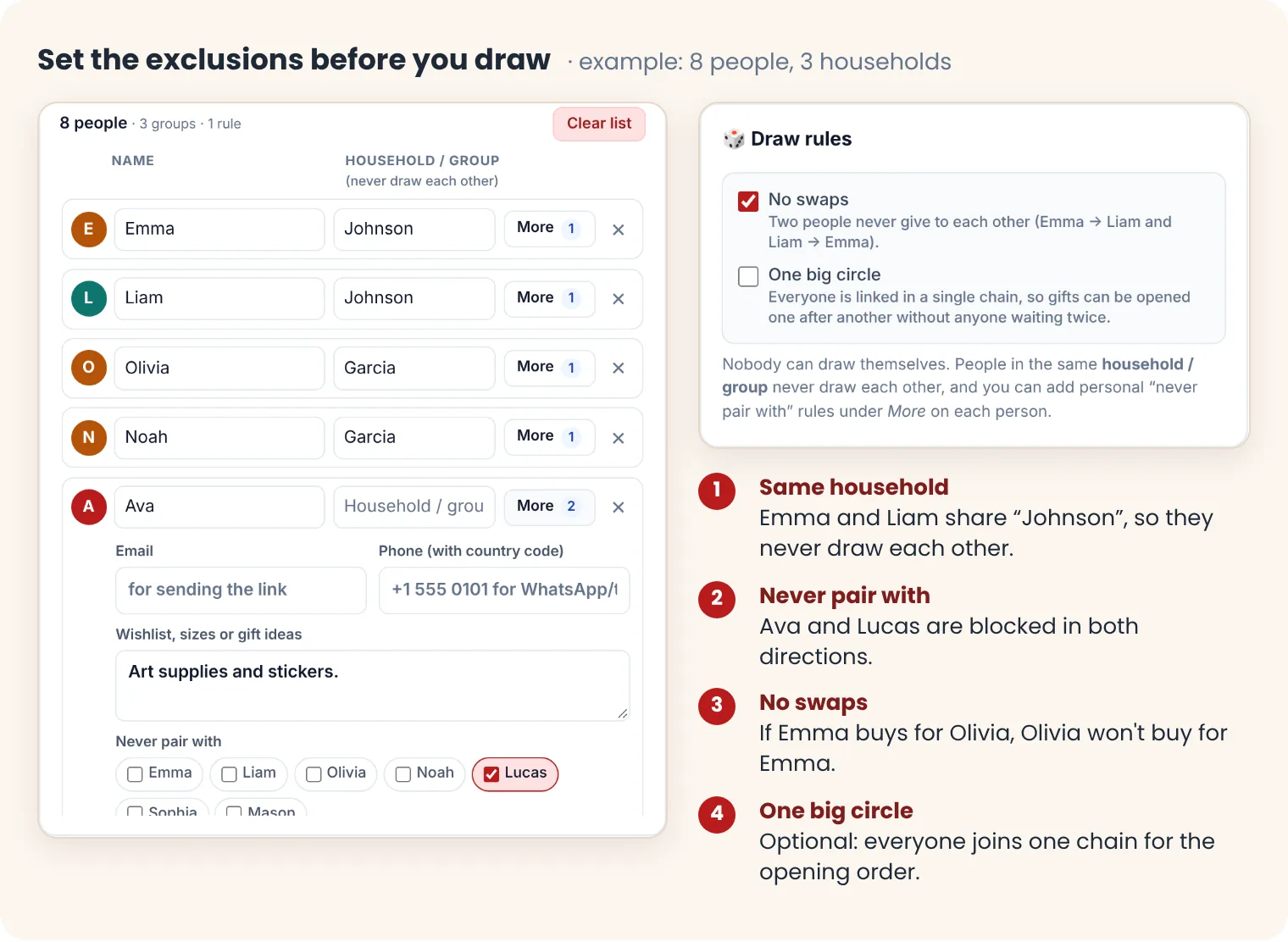
- Households. Partners and people who live together already buy for each other. Put them in one household, for example “Johnson”, and the draw keeps them apart.
- Never pair with. For anything else, such as a manager and their direct report, siblings who swapped last time or two people who don't get along, block that specific pair.
- No swaps. Keep this on. It stops two people from simply trading gifts with each other.
Use exclusions sparingly. Each rule removes possible matches, and in a small group too many rules can leave someone with nobody left to draw. If that happens, the generator tells you which person is stuck so you can relax one rule instead of guessing.
Consider one big circle
A normal random draw is perfectly fair, but it can split your group into several separate loops. If you want the exchange to feel like one shared event, connect the whole group into a single loop:
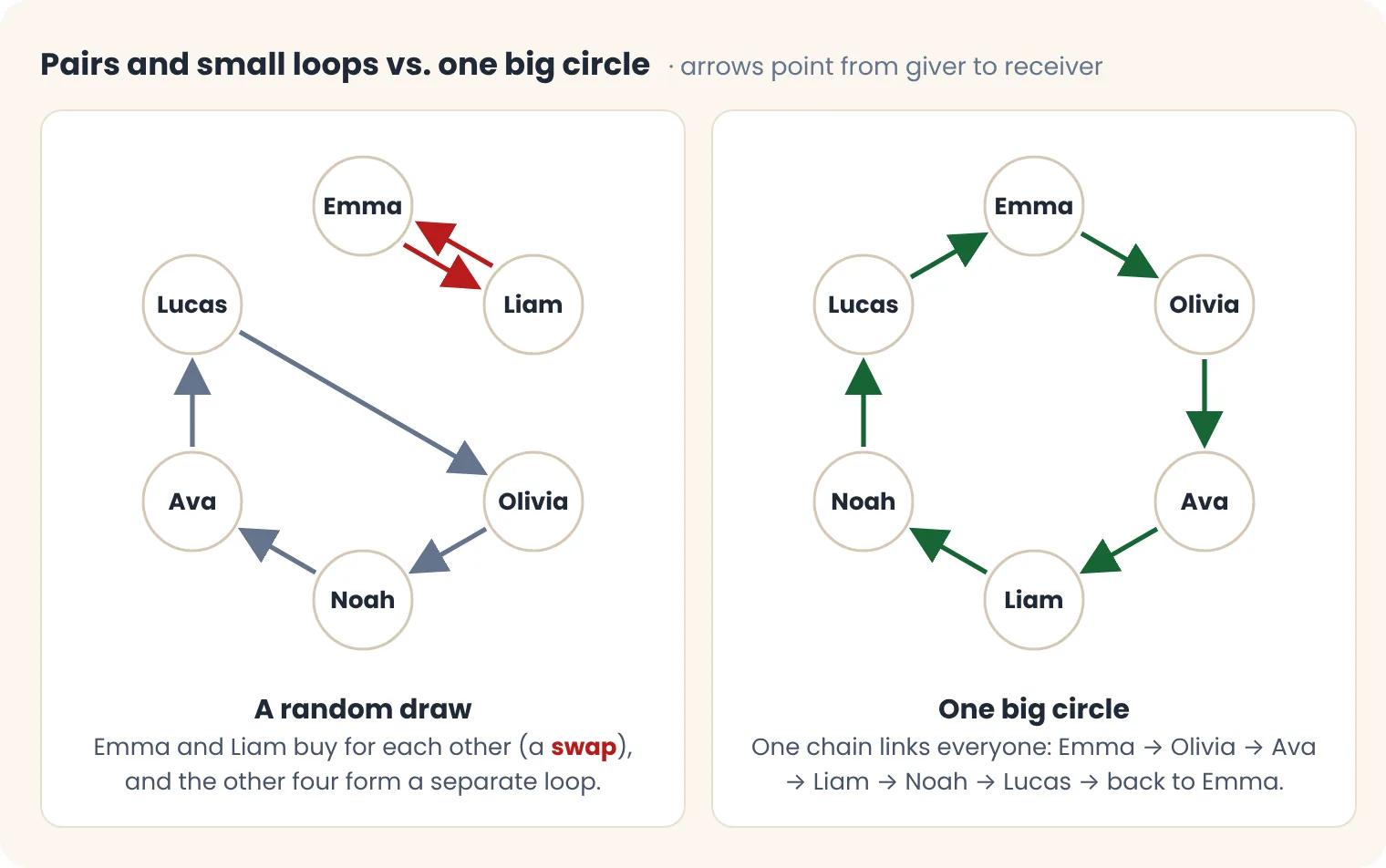
The chain doubles as a game plan for the party: the first person hands over their gift, the receiver opens it and passes on their own gift, until the last present goes back to whoever started. If you organize without taking part yourself, the list of matches follows the chain, so you can read out the order.
Avoid last year's matches
If your group does this every year, nobody wants the same person twice in a row. Keep the previous round, and the generator avoids last year's pairs automatically when you start the next exchange.
Step 6: Tell everyone who they got
The draw only works if each person learns their match privately, and the organizer doesn't have to see the list. There are three ways to do it, and the right one depends on where your group is:
| Method | Best for | Watch out for |
|---|---|---|
| Private links | Groups that don't meet before the exchange: offices, remote teams, families in different cities. | Tell people not to forward their link; whoever opens it sees the match. |
| Pass the phone | Everyone together in one room, such as a team meeting or a family dinner. | Ask people to step aside and hide the screen while they look. |
| Printed slips | Classrooms, older relatives and anyone who loves the paper tradition. | Whoever prints sees every match, so let a non-participant do the printing. |
Private links
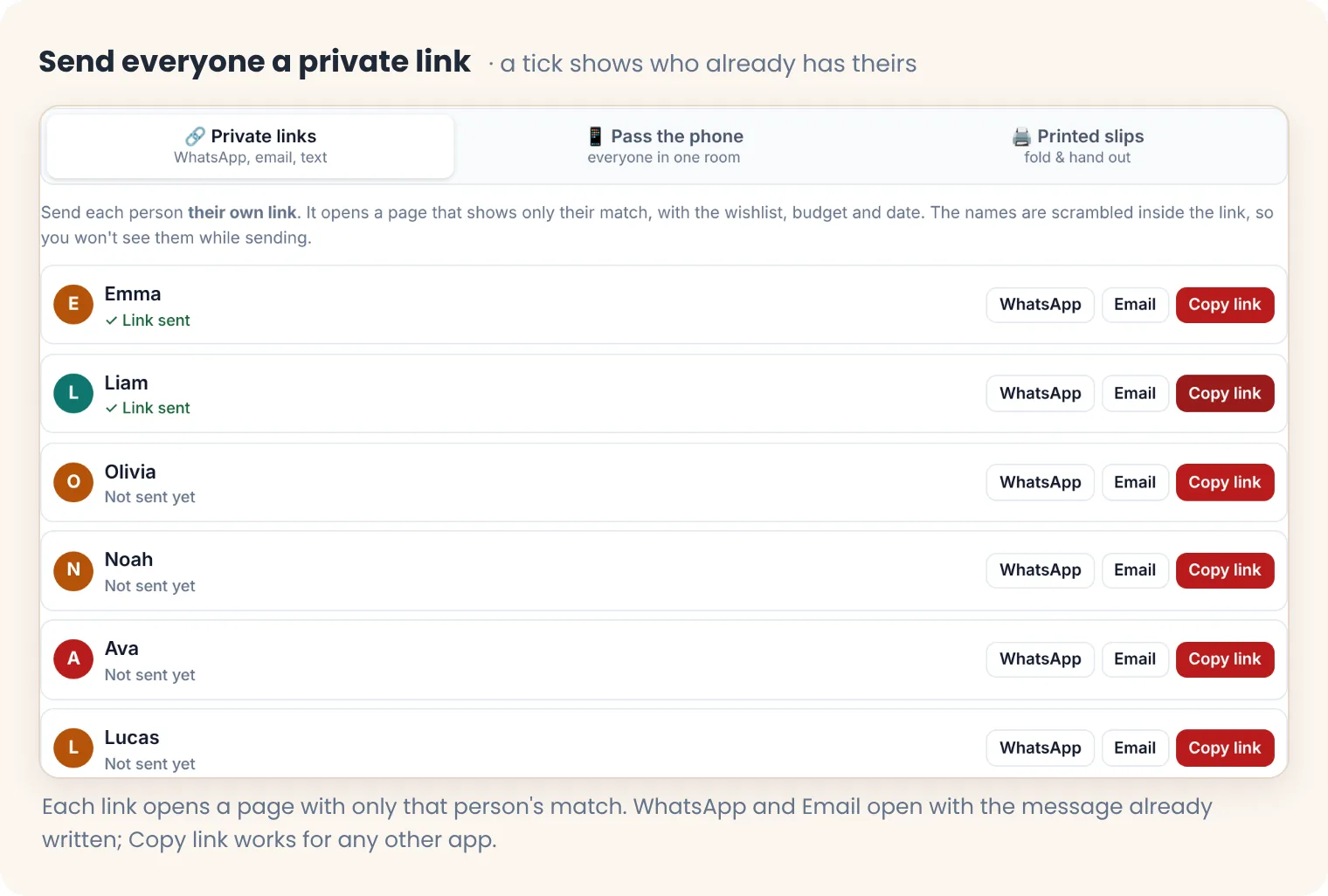
After the draw you get one link per person. Send each one by WhatsApp or email with a message that's already written, or copy it into any other app. A tick shows which links have gone out, so you can't skip anyone.
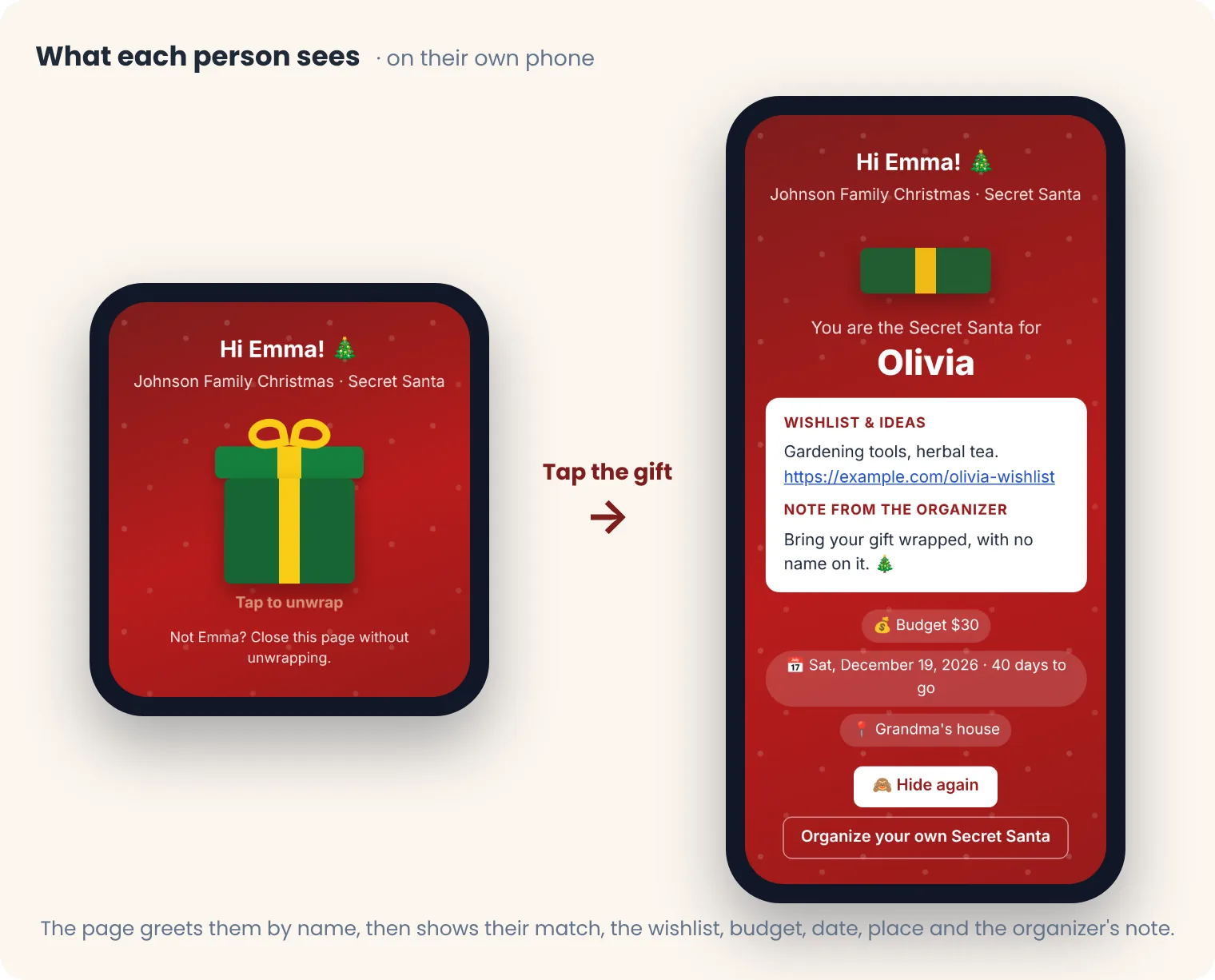
When people open their link, they see only their own match, together with everything they need to go shopping:
Pass the phone
If the whole group is together, one device is enough. Pass it from person to person: everyone finds their name, confirms who they are, reads their match away from prying eyes and closes it before the next person's turn. A check mark shows who has already had a go, so nobody is forgotten.
Printed slips
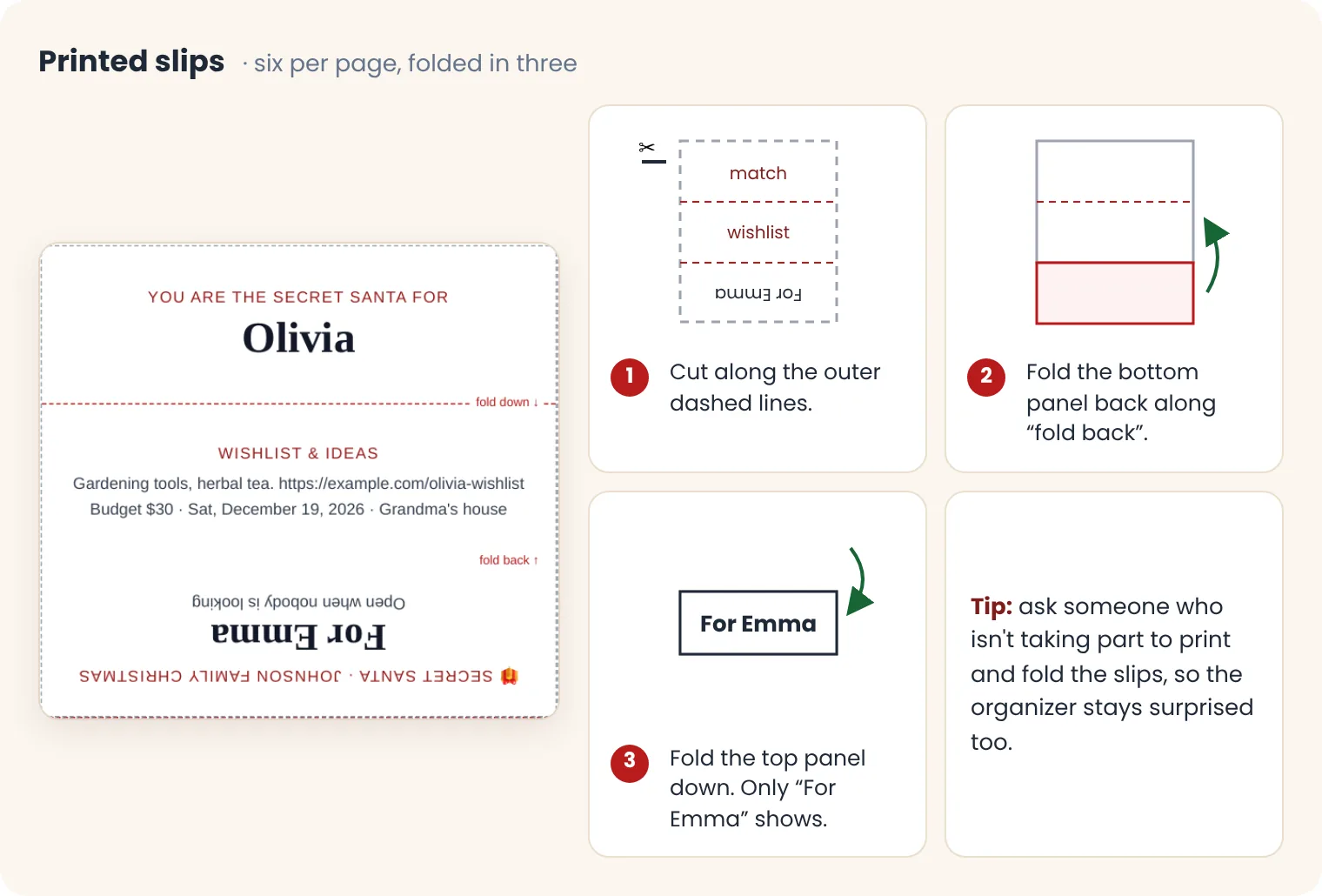
For the classic feel, print the slips, cut along the lines and fold every slip in three, so only the “For …” label stays visible:
If you take part yourself, don't look at the matches. Only open the full list if something needs sorting out, and if you need it from the start, have a friend outside the exchange run the draw.
Running a long-distance or remote Secret Santa
Remote exchanges work well with a little extra planning:
- Ship straight to the receiver. Ask for a shipping address in the wishlist, so only the giver sees it, and order directly to that address.
- Bring the shipping deadline forward. International parcels can take two weeks or more in December. Ask everyone to order at least 10–14 days before the exchange.
- Allow digital gifts if your group agrees: e-books, online classes, streaming months or gift cards, which arrive instantly and cost nothing to ship.
- Unwrap together on a video call. Ask everyone to keep their parcel closed until the call, and choose a time that works across time zones.
- Use one currency for the budget, and let people round to whatever is normal where they live.
Office Secret Santa: keep it inclusive
At work, a Secret Santa should bring people together, not create pressure. A few habits make that much more likely:
- Keep joining optional and the budget modest, and make sure nobody can tell who declined.
- Use the same budget for everyone, whatever their role. Managers who join should stick to it too.
- Steer clear of gifts that could offend: anything suggestive, religious or about weight, and gag gifts aimed at a person.
- Include remote colleagues with shipped gifts or digital gifts and a short video call.
- Exclude manager and direct-report pairs if that would feel uncomfortable in your team.
- Hold the exchange during working hours, so people with family duties can join.
Gift ideas by budget
When a wishlist is thin, these ideas suit most people. Use them as a starting point and adapt them to what you know about your giftee:
| Budget | Ideas |
|---|---|
| Under $15 | Specialty chocolate or tea, fun socks, a small plant, a quality notebook, a card game, a hot sauce or spice set |
| $15–$30 | A favorite author's new book, a cozy throw or scarf, a nice mug with good coffee, a puzzle, a desk organizer, a cookbook |
| $30–$50 | A board game, wireless earbuds or a phone stand, a reading light, a hobby starter set, a quality water bottle, a class or experience voucher |
Little touches matter more than price: a handwritten card, nice wrapping and a gift receipt for anything with a size.
Exchange day: games and reveal ideas
The exchange is the payoff for weeks of planning, so give it a little structure:
- Guess your Santa. After opening their gift, each person gets one guess. Reveal the giver only after everyone has guessed, or keep the secret forever if your group prefers.
- Open in chain order. With one big circle, the receiver of each gift opens next, so everyone gets their moment.
- Two clues. Each giver writes two clues about themselves on the gift tag, and the receiver guesses from those.
- A group photo with everyone holding their gift makes a great memory for next year's invitation.
If you're hosting the exchange over a sit-down dinner, our Place Card Maker creates matching place cards for the table.
When things go wrong
Even well-planned exchanges hit a snag or two. Here's how to handle the usual ones:
- Someone drops out after the draw. Remove them and draw again, then resend all links. Everyone gets a new match and the first links keep showing the earlier draw, so tell the group to use only the new link. If shopping has already started, the organizer can simply buy the extra gift instead.
- Someone wants to join late. Same fix: add them, draw again and send the new links to everyone, with a note to ignore the first one.
- Someone lost their match. Send them their link again; it still works and shows the same match.
- Your rules leave nobody to draw. The generator names the person who is stuck. Remove one rule, split a large household into two groups or turn off one big circle, then try the draw once more.
- Someone shows up without a gift. Keep one or two neutral backup gifts, such as chocolates or a nice notebook, so nobody leaves empty-handed.
- Someone guesses their Santa early. It happens. Laugh it off and keep the rest of the exchange secret.
Next year: start from where you left off
A good Secret Santa often becomes a tradition. Save your exchange, and next year start a new round with the same group. People can be added or removed, the budget and date updated, and last year's pairs are avoided automatically. Your notes about what worked, from the budget to the date, are already in place.
Organizer's checklist
- ☐ Format chosen and participants confirmed (opt-in)
- ☐ Date, place and budget decided
- ☐ Rules message sent
- ☐ Wishlists collected, with addresses for remote people
- ☐ Households and never-pair rules set
- ☐ Names drawn two to three weeks before the exchange
- ☐ Every person has their match (all links sent, phone passed or slips handed out)
- ☐ Shopping and shipping reminder sent
- ☐ Backup gift bought
- ☐ Exchange held, and the group saved for next year
Ready to draw? Open the Secret Santa Generator, add your group and your rules, and send everyone their private match in a few minutes. It's free, needs no sign-up, and the list stays on your device.